Multi Angle Measuring Tool: 7 Practical Uses & Buying Guide
This guide is based on the provided product images, official specifications, and general woodworking and measuring tool knowledge.
Introduction
A multi angle measuring tool makes it much easier to copy irregular angles and transfer them accurately onto tile, wood, flooring, and other materials.
If you’ve ever tried to fit a tile around a doorframe, a pipe, or some odd little jog in a wall, you know the problem isn’t cutting the tile — it’s figuring out the angle in the first place. A standard protractor only gets you one line at a time,
and eyeballing it usually means a wasted tile and a trip back to the saw. The Multi Angle Measuring Tool, sometimes sold as the Tile Hole Maker or Angle Template Tool, multi angle measuring tool is built to solve exactly that. It’s a six-sided folding aluminum tool that lets you press it right against a corner, lock the angle, and trace it directly onto your material. No math, no guessing.
What Is a Multi Angle Measuring Tool?
At its core, this is a mechanical angle-copying tool. Instead of measuring degrees and transferring numbers to a square, you fold and slide the arms until they match the shape you’re working with — a corner, a step, an irregular edge — then lock everything in place with the built-in knobs. Once it’s locked, the tool becomes a physical stencil. You trace along the arms with a pencil or marker and you’ve got your cut line, angle and all.
It’s a tool that’s been popular with tile setters and flooring installers for years, and the same idea works just as well for carpenters and DIYers dealing with odd angles in wood, brick, or pipe.
Product Overview
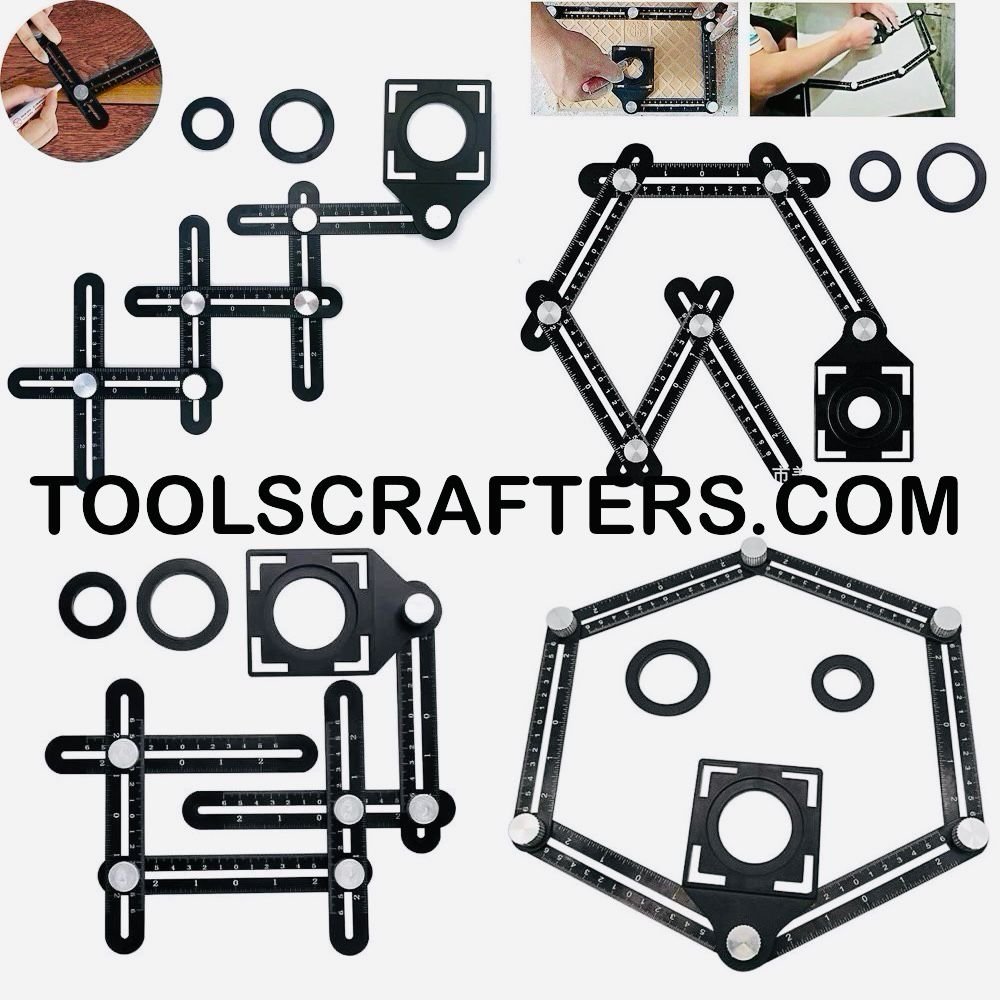
The tool is made from aluminum alloy and built around a six-arm folding design. Each arm carries a printed ruler scale along its length, and the arms connect at pivot points fitted with round, knurled locking knobs. Two sizes of rubber gaskets are included and sit at those pivot points during setup. A separate accessory is also included — a square plate with a circular cutout and its own small locking screw — which is meant for tracing round openings, like the hole you’d need for a pipe coming through a tile or floor. multi angle measuring tool
Beyond that, the images don’t give us details on exact dimensions, weight, or measurement units printed on the scale, so we won’t guess at those. If it matters for your project, it’s worth checking with the seller directly before you buy.
– Material: Aluminum alloy
– Design: Six-sided folding arms
– Scale: Printed ruler markings on each arm
– Locking: Knurled metal knobs at each joint
– Included accessories: Rubber gaskets, hole template plate
– Thickness, weight, accuracy rating: Not specified
Design & Features
Folding Arms
The six arms fold down into a compact zigzag shape for storage, and unfold to capture almost any angle you throw at them. The benefit here is flexibility — instead of owning three or four different angle tools, one tool adjusts to fit the corner in front of you.
Sliding Ruler Arms
Each arm sits in a slotted track, so the connecting screw can slide along the length of the arm, not just pivot. That matters when you’re copying a layout that isn’t a clean, sharp angle — it lets the tool stretch or compress to match uneven spacing.
Locking Knobs
The round knurled knobs tighten by hand at every joint. Once you’ve matched your angle, you twist the knob and the arm stays put while you move the tool to your material and trace it. No wrench needed, which is handy when you’re up a ladder or working in a tight spot.
Rubber Gaskets
Two gasket sizes are included and are placed at the pivot points before the arms are set. These help the joint hold its position and protect the surface it’s resting against while you’re aligning the tool.
Hole Template Plate
This can help reduce repeated measuring when marking circular cutouts around plumbing fixtures.
This is the piece that earns the tool its “Tile Hole Maker” nickname. It’s a flat plate with a circular opening and a locking screw, made for tracing round cutouts — the kind you need when a pipe or fitting has to pass through a tile.
Common Applications
Tile Installation
Helps you transfer irregular corner shapes onto a tile before you cut it, so the piece drops into place the first time instead of needing a second attempt.
Flooring
Useful for marking complex floor edges — around cabinets, thresholds, or vents — before you cut the flooring material to fit.
Carpentry
Handy for copying corner angles onto wooden boards, trim, or framing pieces where a standard square won’t capture the shape.
Woodworking
Works for transferring angles onto stock before cutting joints or fitting pieces around an irregular edge.
Pipe Layout
The hole template plate makes it easier to mark where a pipe needs to come through tile, flooring, or a wall panel.
Brick Work
Can be used to trace angles along uneven brick edges or corners before cutting or fitting a piece.
DIY Projects
Good for shelves, furniture builds, and general home improvement work where you need to match an angle instead of calculating one.
Comparison Table
| Surface | Typical Use |
|—|—|
| Tile | Marking corner and hole cutouts before cutting |
| Wood | Copying angles onto boards or trim |
| Brick | Tracing uneven edges or corners |
| Flooring | Marking floor edges around fixtures |
| Pipe Layout | Tracing round openings with the hole template plate |
| Concrete | Marking edge angles before cutting or fitting |
How to Use
Using the tool comes down to five steps, based on the instructions shown with the product.
First, you insert the locking screw into the arm joint you’re working with.
Next, fit one of the rubber gaskets at that same joint before you tighten anything down — this keeps the joint seated properly.
From there, align the next arm against the surface you’re copying and place the second gasket the same way.
Once both sides are lined up, glide the shorter arms until they match the angle or shape in front of you — this is really the heart of the process, since it’s where the tool actually “reads” your corner. Finally, tighten the locking knobs so nothing shifts, then trace along the outer edge of the arms to stencil your cut line onto the tile, board, or material you’re working with.
It’s worth taking your time on the “glide the arms” step. Rushing it is the most common way to end up with a slightly-off angle.
Before making the final cut, double-check the traced layout to avoid material waste.
Pros
– Captures irregular and multi-sided angles in one setup, which a standard angle finder can’t do
– Folds flat for storage and transport
– Hand-tightened knobs mean you don’t need extra tools to lock an angle
– The hole template plate adds circular cutout marking, useful for pipe work
– Shown working across several materials, including wood, tile, brick, and concrete
Cons
– The printed scales are small, so reading exact numbers can take a careful eye
– Several small parts — gaskets, screws, the template plate — are easy to lose track of
– No storage case or pouch is shown with the product
– Measurement accuracy, unit of scale, and long-term durability of the gaskets aren’t specified
Buying Guide
If you’re deciding whether this type of tool fits your work, a few things are worth thinking through before you buy.
Number of folding arms matters for how complex an angle you can capture — six arms give you more flexibility than a basic two- or four-arm tool.
Locking mechanism is worth checking too. Hand-tightened knurled knobs, like the ones on this tool, are convenient on site since you’re not digging for a screwdriver.
Material affects both weight and how well the tool holds up to daily use — aluminum alloy is common for this style of tool because it’s light without being flimsy.
Included accessories vary between sellers. Not every version of this tool comes with the hole template plate or the gaskets, so it’s worth confirming what’s actually in the box.
Storage is a small but practical point — since the tool folds down, think about where you’ll keep it so the small parts don’t wander off.
Intended projects should guide the decision more than anything else. If you’re mostly doing straightforward tile work, a simpler angle tool might be enough. If you’re regularly dealing with odd corners, pipe cutouts, or mixed materials, the extra features here start to pay off.
Ease of reading Choose a tool with clear and easy-to-read measurement markings, especially if you work in low-light conditions. multi angle measuring tool
Maintenance & Care
A tool like this doesn’t need much, but a little care goes a long way. Wipe it down after use, especially if you’ve been working with wet tile adhesive, grout, or dusty materials — buildup on the arms can make the printed scale harder to read over time. Store it somewhere dry to avoid corrosion around the joints and knobs. Every so often, check that the locking knobs still tighten firmly; a joint that’s loosened up won’t hold an angle accurately. Keep the ruler markings clean so you can read them at a glance instead of guessing. And since it’s a folding tool with moving joints, try not to drop it — a hard knock can throw off the alignment of the arms.
Avoid overtightening the locking knobs, as unnecessary force may increase wear over time.
FAQ
Can this tool fold for storage?
Yes. The six arms fold down into a compact zigzag shape, which makes it easier to store in a toolbox or bag than a rigid angle finder.
Is it suitable for DIY users?
Yes. The hand-tightened knobs and straightforward “glide and lock” process make it approachable even if you don’t do this kind of layout work every day.
What materials can it be used on?
Based on the product images, it’s shown in use on wood, tile, brick, and concrete surfaces, along with pipe layout marking using the hole template plate.
What is the hole template plate for?
It’s a separate plate with a circular cutout, used to trace round openings — most commonly for pipes or fittings that need to pass through tile or flooring.
Do I need extra tools to lock an angle in place?
No. The knurled locking knobs are designed to be tightened by hand at each joint.
What are the rubber gaskets used for?
Two sizes of gaskets are included and placed at the pivot points during setup, based on the steps shown with the product, before the arms are angled and locked.
Is the measurement scale in inches or centimeters?
Not specified. If the unit of measurement matters for your project, it’s best to confirm with the seller before purchasing.
How We Evaluated This Product
This guide was prepared using the product images provided, the official specifications listed by the seller, and general woodworking and measuring tool knowledge. No independent testing has been performed or claimed. Where a detail wasn’t visible in the images or included in the specifications — such as exact measurement units, weight, or accuracy rating — it’s been marked as “Not specified” rather than assumed.
Final Thoughts
multi angle measuring tool A tool like this isn’t for every job. If most of your work is straight cuts and standard corners, a basic angle finder will probably cover you. But if you regularly run into odd angles, tricky corners, or pipe cutouts in tile and flooring work, multi angle measuring tool a folding multi-angle tool like this one can save you a fair amount of trial and error. Whether it’s worth adding to your kit really comes down to how often you deal with irregular layouts in your own projects.
Affiliate Disclosure
This article may contain affiliate links. If you purchase through one of these links, we may earn a small commission at no additional cost to you. This does not affect our evaluation of the product.
About TOOLSCRAFTERS
TOOLSCRAFTERS covers hand tools, measuring tools, and DIY equipment for tile setters, carpenters, and home improvement enthusiasts, with guides based on manufacturer specifications, product imagery, and general trade knowledge.
—
Related Reading
– Tile Cutting Tools: What You Need for Corners and Pipe Cutouts
– A Beginner’s Guide to Angle Finders and Protractors
– Essential Layout and Measuring Tools for Carpentry
– Flooring Installation Tools Checklist
– DIY Tools Every Beginner Should Own