
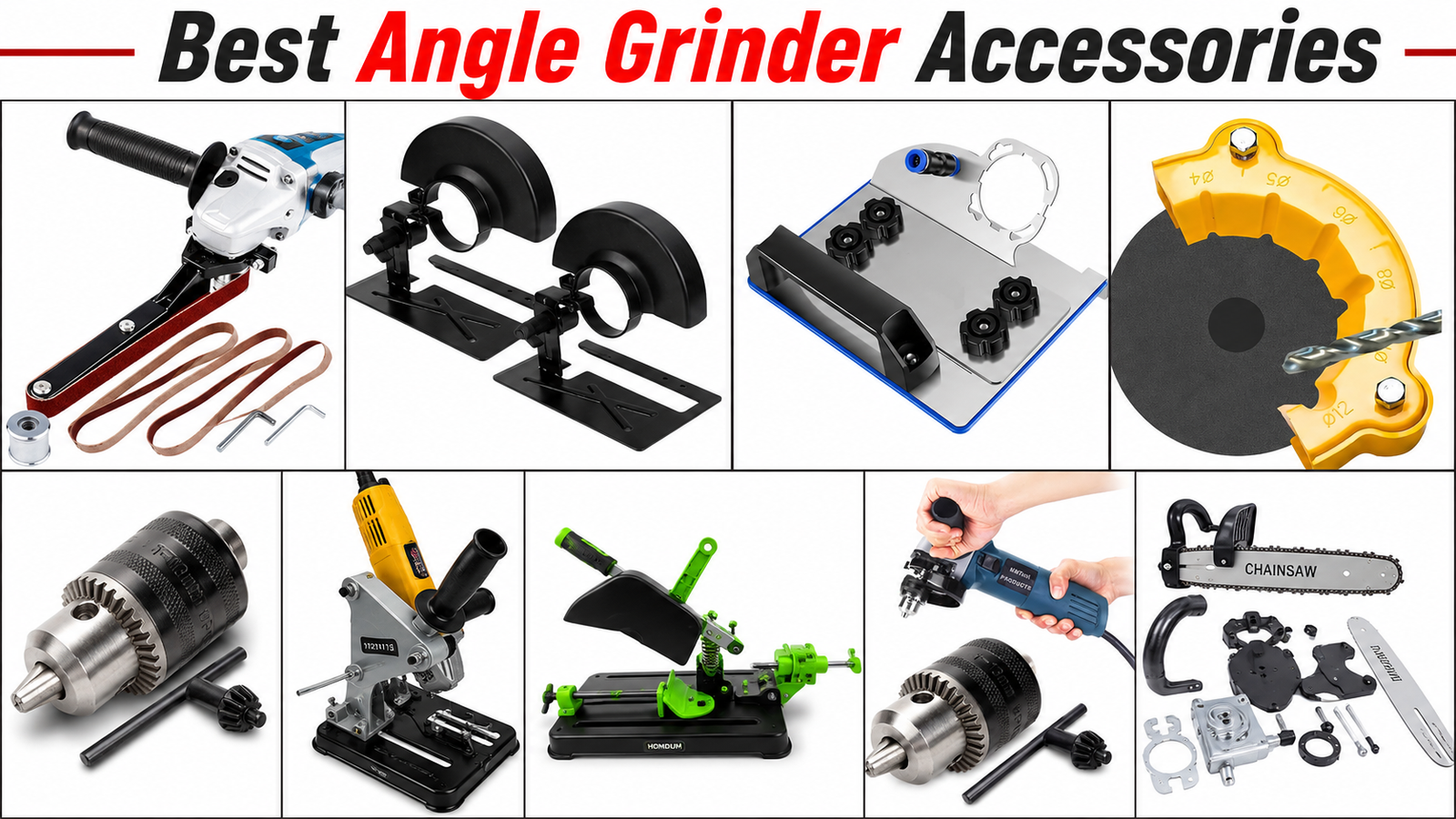
Best Angle Grinder Accessories (2026): 10 Useful Attachments Reviewed
Last Updated: July 2026
Table of Contents
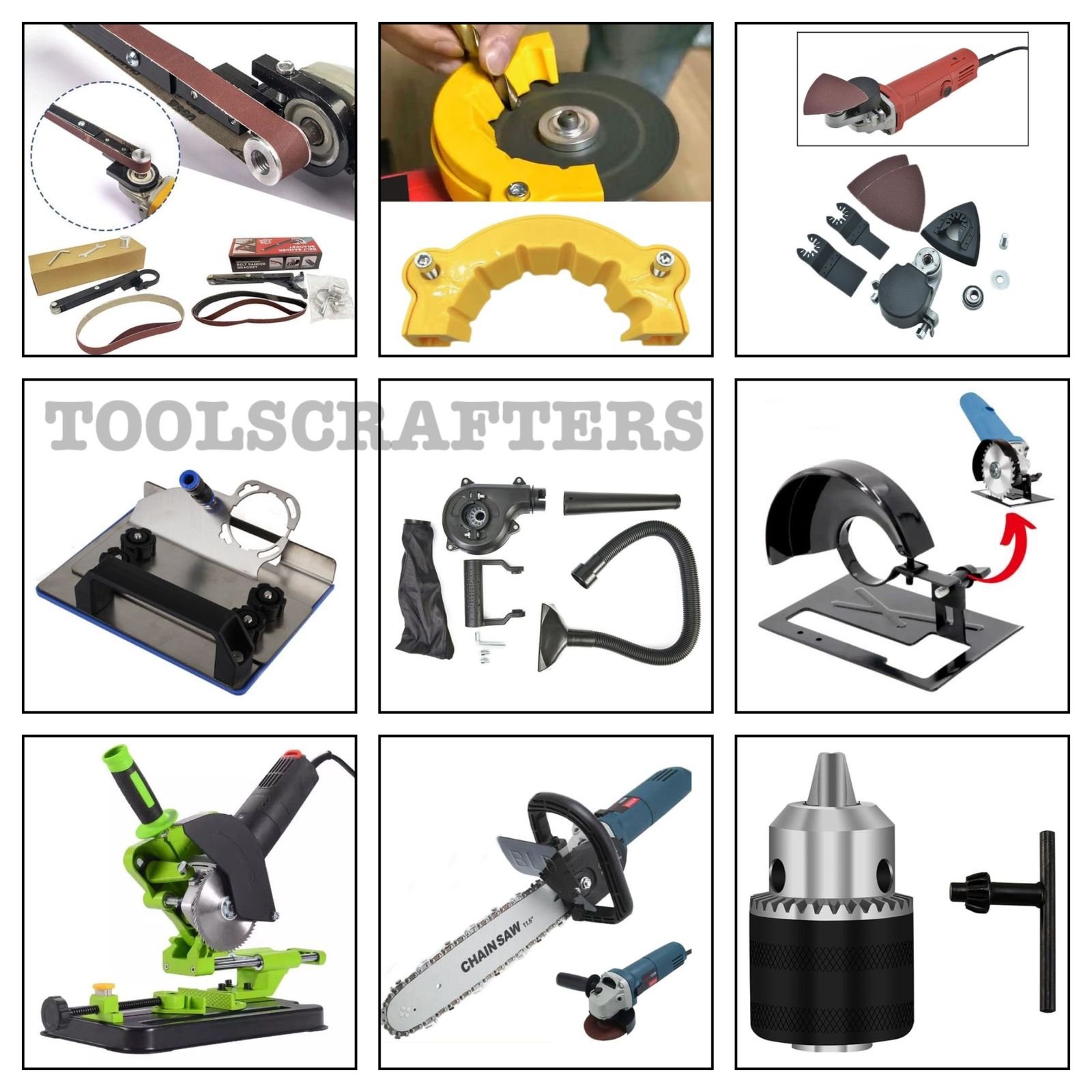
– What These Attachments Can and Can’t Do
– Quick Decision Chart
– Sliding Compound Saw Stand
– Angle Grinder Chainsaw Attachment
– Mini Circular Saw Base Stand
– Angle Grinder Belt Sander Attachment
– Angle Grinder Air Blower Kit
– Oscillating Multi Tool Attachment
– 13mm Drill Chuck Adapter
– 45° Tile Chamfer Cutting Stand
– Angle Grinder Drill Bit Sharpener
– Universal Angle Grinder Safety Cutting Stand
– Angle Grinder Attachments Compared
– Buying Mistakes to Avoid
– Safety Rules That Apply Across All Attachments
– Frequently Asked Questions
Introduction
Most workshops already have an angle grinder sitting somewhere near the vice or under the bench. It’s one of those tools that gets bought early and used constantly, but rarely for anything beyond cutting metal or knocking down a weld. What a lot of people don’t realise is that the same grinder can be turned into several other tools with the right attachment — a saw stand, a sander, even a drill in a pinch.
This article goes through ten angle grinder accessories that genuinely extend what your grinder can do. Some of them are excellent value. A few are only worth it in specific situations. None of them turn your grinder into a full replacement for a dedicated machine, and I’ll say exactly where each one falls short, not just where it helps. If you’re deciding whether to buy an angle grinder accessory instead of a separate power tool, this should give you enough to make that call properly.
A quick note before we start: exact fitment, chuck sizes, and load ratings differ between manufacturers, so specifications vary by manufacturer throughout this guide. Always check your own grinder’s spindle size, disc diameter, and body shape against the attachment you’re considering before buying.
Who Should Read This Guide?
This guide is designed for anyone who already owns an angle grinder and wants to get more value from it without buying several separate machines.
You’ll find it especially useful if you’re:
– DIY enthusiasts working on home improvement projects
– Carpenters looking for more versatile workshop setups
– Fabricators handling light metalwork and finishing
– Electricians cutting conduit, rod, or metal brackets
– Plumbers working with pipe, fittings, and tile
– Maintenance technicians who need practical multi-purpose tools
– Small workshop owners looking to reduce tool costs
If your work involves daily production or industrial-scale cutting, sanding, drilling, or tree work, this guide will also help you understand when an attachment is no longer the right solution and when investing in a dedicated machine makes more sense.
What These Attachments Can and Can’t Do
None of these ten accessories are trying to replace your grinder. They mount onto it, use its motor, and give it a second (or third) job. That’s the appeal — you already own the power source, so the attachment itself is usually far cheaper than buying a whole new tool.
The trade-off is control. An angle grinder was designed to spin a disc at a fixed, fairly high speed. Saws, drills, sanders, and chainsaws are usually built with variable speed, clutches, or specific safety mechanisms suited to their job. When you bolt a saw stand or a chuck adapter onto a grinder, you’re borrowing the motor but not the engineering behind those other tools. That’s fine for occasional use. It’s usually not fine for daily production work.
Keep that one idea in mind as you go through the list: these are extenders, not replacements. Some come close. Others are clearly stopgaps. I’ll tell you which is which.
One more safety point that’s often overlooked is attachment speed rating. Before fitting any accessory, check that its maximum rated RPM is equal to or higher than your angle grinder’s no-load RPM. Using an attachment that’s rated below the grinder’s speed can lead to premature failure and may create a serious safety hazard.
Quick Decision Chart
If you only read one table on this page, read this one.
| Accessory | Best For | Skip If | Replaces Dedicated Machine? | Worth Buying? |
|—|—|—|—|—|
| Sliding Compound Saw Stand | Straighter, safer cuts on stock and tile | You cut at high volume daily | Partially | Only if you freehand-cut regularly |
| Chainsaw Attachment | Occasional branch and small log trimming | You do regular tree work | No | Only for light, occasional use with real safety precautions |
| Mini Circular Saw Stand | Occasional plywood, MDF, PVC cuts | You cut sheet goods daily | Partially | Only for occasional thin-board work |
| Belt Sander Attachment | Deburring, knife sharpening, small finishing jobs | You sand large surfaces regularly | Partially | Only for occasional, detail-level sanding |
| Air Blower Kit | Quick workshop dust cleanup | You need serious outdoor blowing power | No | Only for light indoor cleanup |
| Oscillating Multi Tool | Flush cuts, corner sanding, scraping | You do this kind of detail work daily | Partially | Only if occasional and you don’t already own a dedicated multi-tool |
| 13mm Drill Chuck Adapter | Rare, occasional drilling | You drill regularly or need precision | No | Only for rare, non-precision holes |
| 45° Tile Chamfer Stand | Occasional tile edge finishing | You tile professionally at volume | Partially | Only for small-scale tile work |
| Drill Bit Sharpener | Restoring dulled (not damaged) bits | You rarely drill at all | Yes, for this specific job | Yes, if you drill often enough to dull bits |
| Universal Safety Cutting Stand | Safer, more accurate freehand-style cutting | You run high-volume production cutting | Partially | Yes, if you freehand-cut stock regularly |
Now let’s go through each one properly.
1. Sliding Compound Saw Stand

What It Is
A stand with a sliding or pivoting arm that holds your angle grinder in place, so instead of holding the grinder freehand you lower it onto the workpiece along a fixed, controlled path.
How It Works
The grinder clamps into a bracket mounted on the arm. You pull or lower a handle, and the spinning disc comes down onto the material in a straight, repeatable line, usually against a base or fence that keeps the workpiece steady.
Real Applications
This one earns its place in a lot of trade vans. Electricians use it for cutting conduit and threaded rod cleanly. Plumbers use it on pipe and fittings. Carpenters use it on small profiles and trim stock. It’s also handy for cutting tile when fitted with the right disc.
Advantages
The biggest win here is stability. Freehand grinding on small stock is genuinely risky — the disc can grab, the material can shift, and your cut line drifts. Clamping the grinder into a stand removes most of that risk and gives you a straighter, more consistent cut every time.
Limitations
It’s not a mitre saw. There are no angle presets, no depth stop, and the cut capacity is limited by your disc size. If you’re cutting the same joint angle fifty times a day, this stand will slow you down compared to a proper compound mitre saw, and the lack of fine-tuned angle control will start to show in the consistency of your cuts.
Who Should Buy
Anyone who’s currently cutting rod, pipe, angle iron, or small profiles freehand and wants a safer, straighter result without buying a dedicated saw.
Who Should Skip
Fabricators running high daily cutting volume. A proper chop saw or mitre saw will outlast this setup and cut faster with less operator fatigue.
Safety Tips
Match the disc to the material — a metal-cutting disc for metal, a diamond disc for tile. Confirm the clamp holding the grinder is fully tightened before switching it on. Keep your hands well clear of the arc the arm travels through, and never run the stand with the guard removed.
Buying Advice
Check the clamp diameter against your grinder’s body size before ordering. This is the single most common fitment mismatch — grinders vary enough in body diameter that a stand built for one size won’t always clamp securely on another.
Maintenance
Metal dust and tile slurry build up in the pivot and slide mechanism over time. Clear it out regularly so the arm keeps moving smoothly, and recheck the clamp bolts periodically, since vibration from repeated use tends to loosen them.
Compatibility
Clamp fit varies by grinder brand and body size. Specifications vary by manufacturer, so confirm compatibility before buying rather than assuming a universal fit.
Common Mistakes
The most common one is assuming “universal fit” claims without checking your actual grinder diameter. The second is using the wrong disc for the material. The third is either over-tightening the clamp, which can stress the grinder body, or under-tightening it, which lets the grinder shift mid-cut.
Can It Replace the Dedicated Machine?
Partially. It’s a real improvement over freehand cutting in terms of safety and straightness, but it doesn’t have the angle presets, depth control, or daily-use durability of a purpose-built chop saw or mitre saw.
Quick Verdict
Worth Buying? Only if… you regularly find yourself cutting stock or tile freehand and want a safer, more consistent result without the cost of a full saw. If you’re already running a mitre saw for this kind of work, you don’t need this stand as well.
2. Angle Grinder Chainsaw Attachment

What It Is
A bolt-on bar-and-chain kit, typically around 11.5 inches, that replaces the grinder’s disc with a small chain, turning it into a compact chainsaw.
How It Works
The kit swaps the disc for a sprocket, which drives a mini chain around a guide bar. The grinder’s motor and spindle do the work, the same way they would spinning a cutting disc.
Real Applications
This is genuinely useful for occasional garden work — trimming branches, cutting small logs, clearing fallen limbs after a storm. It’s not something you’d reach for daily, but for the odd job, it saves buying a chainsaw you’d rarely use.
Advantages
You get chainsaw-style cutting from a tool you already own, without the cost or storage space of a full chainsaw.
Limitations
This is the one attachment on this list I’d flag as genuinely higher risk. Angle grinders were never designed with chainsaw safety features in mind — there’s no chain brake, no anti-kickback design built into the tool itself the way there is on a real chainsaw. The grinder also wasn’t engineered for the sideways loading and vibration that chain-cutting produces, which puts extra strain on the spindle and bearings over time. None of that makes it unusable, but it does mean this attachment demands more caution than the others.
Who Should Buy
DIY users and maintenance staff who occasionally need to trim branches or deal with small wood, and don’t want to buy a dedicated chainsaw for something they’ll use twice a year.
Who Should Skip
Anyone doing regular tree work, cutting firewood at volume, or working professionally in landscaping. A real chainsaw — petrol or battery — is safer and considerably more capable for that kind of workload.
Safety Tips
Wear gloves and full eye and face protection. Keep both hands on the tool at all times. Never cut above shoulder height. Check chain tension before every single use — a loose chain on this setup is a real hazard.
Buying Advice
Confirm the kit’s spindle thread matches your grinder before buying, and think honestly about the branch and log diameters you’ll actually be cutting. This kit is built for small-scale work, not felling trees.
Maintenance
The chain needs regular oiling and tension checks, same as any small chainsaw. Because this attachment puts the grinder under more stress than normal disc use, it’s worth inspecting the sprocket and mounting point periodically for wear.
Compatibility
Spindle thread size varies by grinder brand — commonly in the M10 or M14 range, but specifications vary by manufacturer, so confirm before buying rather than assuming.
Common Mistakes
Treating it like a proper chainsaw and attempting logs it isn’t built for. Skipping PPE because “it’s just an attachment.” Not checking chain tension, which leads to the chain derailing mid-cut.
Can It Replace the Dedicated Machine?
No. It doesn’t come close to replacing a petrol or battery chainsaw for anything beyond light, occasional branch work. Think of it as a convenience option, not a substitute.
Quick Verdict
Worth Buying? Only if… you need occasional light branch-trimming, you’re comfortable with the extra safety precautions this attachment demands, and you’re not expecting chainsaw-level performance. If you do any regular tree work, buy an actual chainsaw instead.
3. Mini Circular Saw Base Stand

What It Is
A base or sled attachment that mounts your grinder like a small circular saw, letting you guide it across sheet material for a straighter cut than freehand grinding.
How It Works
The grinder sits in a baseplate with an adjustable depth setting, similar in principle to how a circular saw’s shoe controls blade depth. You push the whole assembly along the material rather than holding the bare grinder against it.
Real Applications
Plywood, MDF, thin PVC sheet, and other thin board material where you need a straight edge but don’t want to haul out a full circular saw.
Advantages
Control is the main benefit. Freehand-cutting sheet goods with a bare grinder is awkward and the results are rarely straight. This stand fixes that for lighter material.
Limitations
It’s not built for thick or heavy timber, and it’s not something you’d want to use for repeated long rip cuts in production carpentry. Cut depth and capacity are limited by your disc size, and the range of wood-cutting discs available is narrower than the blade options you’d get with an actual circular saw.
Who Should Buy
DIYers and site workers who occasionally need to cut thin sheet goods and don’t want to carry a second power tool for it.
Who Should Skip
Carpenters doing daily sheet-good cutting, or anyone working with thicker timber. A dedicated circular saw will be faster, safer, and better suited to sustained use.
Safety Tips
Use a disc rated for wood, never a metal-cutting disc. Keep the base flat against the material throughout the cut. Let the disc do the work rather than pushing hard — forcing the cut increases the risk of binding.
Buying Advice
Check that the base fits your grinder’s disc size, and that the depth adjustment range actually suits the material thickness you work with most.
Maintenance
Wood dust and resin build up in the base and depth adjustment mechanism. Clear it out regularly so the base keeps sliding smoothly.
Compatibility
Fit depends on grinder body shape and disc size. Specifications vary by manufacturer, so confirm before buying — some stands are size-specific and won’t clamp properly on a different body shape.
Common Mistakes
Using a metal-cutting disc on wood — wrong tool, poor and genuinely dangerous result. Expecting circular-saw-level cut quality on thick timber. Not checking that the base sits flat against the material before starting the cut.
Can It Replace the Dedicated Machine?
Partially. Fine for occasional cuts in thin sheet material, but it won’t hold up as a substitute for a proper circular saw in daily carpentry work.
Quick Verdict
Worth Buying? Only if… your sheet-cutting needs are occasional and limited to thinner boards. If you’re cutting plywood or MDF every week, a dedicated circular saw will serve you better.
4. Angle Grinder Belt Sander Attachment

What It Is
An attachment that runs a sanding belt over small rollers driven by the grinder’s spindle, effectively turning the grinder into a compact belt sander.
How It Works
The grinder drives a small pulley system that moves an abrasive belt in a loop. It’s the same basic concept as a handheld belt sander, just scaled down and powered by the grinder instead of its own motor.
Real Applications
Wood smoothing, metal finishing, deburring welded edges, and knife or blade sharpening are the jobs this attachment handles well. It’s particularly useful for detail-level finishing rather than broad surface work.
Advantages
It adds sanding capability to a tool you already have, and for small jobs like deburring a weld or touching up a blade edge, it’s genuinely more convenient than dragging out a full-size belt sander.
Limitations
The belt is smaller and the platform less stable than a dedicated bench or handheld belt sander. It’s not the right tool for large surface areas or extended, heavy stock removal — you’ll find belt life and tracking accuracy fall short of a purpose-built sander under that kind of load.
Who Should Buy
Fabricators and metal workers who need occasional deburring or finishing, woodworkers who want light sanding capability without buying a separate tool, and hobbyists doing knife work.
Who Should Skip
Anyone doing regular, large-surface sanding — furniture makers or production shops will get better results and longer tool life from an industrial or bench belt sander.
Safety Tips
Keep loose clothing and gloves clear of the moving belt. Secure the workpiece before starting. Check that the belt is tracking correctly before applying any real pressure.
Buying Advice
Check the available belt grit range for the attachment, and confirm it actually fits your grinder’s spindle and body size before ordering.
Maintenance
Replace worn belts as soon as they lose their cutting ability, and keep the rollers clear of dust and debris — buildup here is the main cause of belts slipping off track.
Compatibility
Spindle and collar size vary by grinder model. Specifications vary by manufacturer, so confirm fit before buying.
Common Mistakes
Applying too much pressure, which this lighter-duty attachment isn’t built to handle. Using the wrong grit for the job. Ignoring belt tracking adjustment, which causes the belt to slip off during use.
Can It Replace the Dedicated Machine?
Partially. Good for small, occasional finishing and deburring work, but not a substitute for an industrial or bench belt sander when the job involves volume.
Quick Verdict
Worth Buying? Only if… your sanding needs are occasional and detail-focused — deburring, knife sharpening, touch-up work. If you’re sanding large surfaces regularly, skip this and get a proper belt sander instead.
5. Angle Grinder Air Blower Attachment Kit

What It Is
An attachment that uses the grinder’s spinning motor to drive a small impeller, generating airflow through a nozzle — essentially a basic blower.
How It Works
A fan or impeller unit mounts where the disc would normally sit. As the spindle rotates, the impeller pushes air out through the attached nozzle.
Real Applications
Blowing sawdust and metal shavings off a work surface, general workshop cleanup, clearing dust from tight corners, even light cleaning of computer components. It’s a convenience tool more than a heavy-duty one.
Advantages
You get blower functionality without buying a separate leaf blower or compressor, and it’s genuinely handy for a quick cleanup between jobs.
Limitations
Airflow and pressure are modest compared to a dedicated blower, shop vac, or compressor. It’s not suited to heavy debris, wet cleanup, or clearing leaves outdoors at any real scale.
Who Should Buy
Anyone who wants a quick way to clear dust and debris in the workshop without adding another standalone tool.
Who Should Skip
Anyone who needs serious outdoor blowing power or high-pressure cleaning — a proper blower or compressor is the right call there.
Safety Tips
Wear eye protection, since blown dust and debris travel unpredictably. Never point it at another person. Fine dust — wood or metal — becomes airborne quickly with this attachment, so a mask is worth wearing when clearing it.
Buying Advice
Confirm the nozzle and impeller unit fits your grinder’s spindle thread before buying.
Maintenance
Clean the impeller blades periodically. Dust buildup here reduces airflow efficiency over time.
Compatibility
Spindle size varies by grinder. Specifications vary by manufacturer, so check before purchase.
Common Mistakes
Expecting leaf-blower-level power from it. Using it on wet or heavy debris it isn’t designed for. Skipping eye and respiratory protection when clearing fine dust.
Can It Replace the Dedicated Machine?
No, for anything beyond light indoor use. It’s a convenience feature, not a substitute for a commercial blower.
Quick Verdict
Worth Buying? Only if… you mainly want quick, light indoor cleanup and don’t need serious outdoor blowing power. For anything heavier, this won’t cut it.
6. Oscillating Multi Tool Attachment (Cutting / Sanding / Scraping)

What It Is
An attachment that converts the grinder’s rotary motion into the rapid back-and-forth oscillation used by multi-tools, and accepts standard oscillating blades, scrapers, and sanding pads.
How It Works
An internal mechanism converts the spindle’s rotation into a small-angle oscillation at the tool head. That oscillation drives whichever accessory you’ve fitted — a flush-cut blade, a scraper, or a sanding pad.
Real Applications
Flush cutting protruding fasteners or door bottoms, sanding into corners, scraping off old adhesive or caulk, floor and cabinet repair, and general trim work in tight spaces.
Advantages
This is genuinely one of the more useful attachments on the list because it does something a plain grinder — or even a saw attachment — simply can’t do: precise, controlled detail work in corners and tight spots. It also accepts widely available standard oscillating accessories, so you’re not stuck sourcing rare parts.
Limitations
You get less power and speed control than a purpose-built oscillating multi-tool, because the conversion mechanism itself is another moving part and another point of wear. For extended, all-day detail work, a dedicated tool will feel more comfortable and consistent.
Who Should Buy
Carpenters, electricians, and maintenance technicians who occasionally need flush cuts, trim adjustments, or scraping work — door trimming, cabinet fitting, floor repair.
Who Should Skip
Anyone doing this kind of detail work every day. A dedicated oscillating multi-tool will outperform the attachment and be far more comfortable to use for long stretches.
Safety Tips
Use the correct blade for the material — wood, metal, and plaster blades aren’t interchangeable. Keep firm control of the tool, since oscillating blades can catch on uneven surfaces. Wear eye protection, particularly when scraping or sanding.
Buying Advice
Check that the attachment accepts a standard oscillating accessory mount. Most use a common arbor pattern, and confirming this keeps you from being locked into rare, hard-to-find blade types.
Maintenance
Keep the oscillation mechanism free of dust, and check the blade clamp is fully tight before each use.
Compatibility
The grinder-side spindle fit varies by brand, but the accessory side is generally more standardised. Specifications vary by manufacturer either way, so check before buying.
Common Mistakes
Using the wrong blade type for the material. Expecting full dedicated-tool performance from the attachment. Not fully securing the blade clamp before starting.
Can It Replace the Dedicated Machine?
Partially. Genuinely useful for occasional detail work, but a proper oscillating multi-tool will outperform it for daily, sustained use.
Quick Verdict
Worth Buying? Only if… you occasionally need flush-cut or scraping capability and don’t already own a dedicated multi-tool. If detail trim work is a daily part of your job, buy the standalone tool instead.
7. 13mm Drill Chuck Adapter (Convert Grinder into Drill)

What It Is
An adapter that replaces the grinder’s disc mount with a 13mm drill chuck, letting you use standard drill bits.
How It Works
The chuck adapter threads onto the grinder’s spindle where the disc and guard would normally sit, transferring the motor’s rotation to a bit held in the chuck.
Real Applications
Occasional drilling when a dedicated drill isn’t on hand — a one-off hole in metal or wood, an emergency fix on site.
Advantages
It adds drilling capability without the cost of a separate drill, which makes sense if you need a hole once in a while and don’t want another tool taking up space.
Limitations
This is where the mechanical mismatch really shows. Angle grinders typically run at a higher, fairly fixed RPM, without the variable speed range or clutch mechanism a proper drill has. That means less control over the bit, faster bit wear, and less accurate holes — especially in metal, where a drill’s slower, more controlled speed matters. Most grinders also don’t have the same trigger-speed modulation as a drill, which takes away fine control exactly when you need it most.
Who Should Buy
DIY users and maintenance techs who occasionally need a hole drilled and don’t want to buy a separate drill for something that happens rarely.
Who Should Skip
Anyone doing regular or precision drilling. A proper corded or cordless drill will give you far better control, speed range, and bit life.
Safety Tips
Because grinder speed and control are noticeably different from a drill’s, start with light pressure and be ready for the bit to grab — this happens more in metal than wood. Secure the workpiece firmly before drilling, and wear eye protection.
Buying Advice
Confirm the chuck adapter’s thread matches your grinder’s spindle before buying.
Maintenance
Keep the chuck jaws clean so they grip the bit reliably.
Compatibility
Spindle thread size varies by grinder brand and model. Specifications vary by manufacturer, so check before purchase.
Common Mistakes
Assuming grinder-speed drilling behaves the same as drill-speed drilling. Using it for precision or repeated drilling work it isn’t suited for. Not securing the workpiece, which leads to the bit grabbing and the whole setup twisting.
Can It Replace the Dedicated Machine?
No. This is a stopgap for rare situations, not a replacement for a proper drill — mainly because of the RPM and control mismatch described above.
Quick Verdict
Worth Buying? Only if… you need drilling capability rarely and already own the grinder. If you drill with any regularity, skip this and buy an actual drill.
8. 45° Tile Chamfer Cutting Stand

What It Is
A guide or jig that holds the grinder at a fixed 45-degree angle, producing consistent chamfered edges on tile.
How It Works
The grinder mounts into the jig at the fixed angle, and the tile is guided along it so the disc removes material consistently at 45 degrees along the edge.
Real Applications
Chamfering tile edges for corner joins and clean finished trim — bathroom and kitchen tile corners, edge finishing on visible tile work.
Advantages
It produces far more consistent chamfers than trying to hold the grinder at 45 degrees freehand, and the finish quality on visible edges improves noticeably.
Limitations
You still need the correct diamond blade, and the result depends heavily on your feed technique and blade condition. This isn’t a substitute for a dedicated wet tile saw when you’re working at volume or need a very high-precision finish.
Who Should Buy
Tilers, plumbers, and contractors doing occasional tile edge finishing who want consistent chamfers without setting up a full wet-saw station.
Who Should Skip
Tiling professionals doing high-volume or premium finish work. A dedicated tile saw will give cleaner, faster, more consistent results at that scale.
Safety Tips
Always use a diamond blade rated for tile — never a metal-cutting disc. Dry-cutting tile produces a lot of dust, so wear a mask and use dust extraction or wet-cutting where possible. Secure the tile firmly in the jig before cutting.
Buying Advice
Check the jig fits your grinder’s disc size, and confirm it’s rated for the tile thickness you typically work with.
Maintenance
Clean tile dust and slurry from the jig regularly, and check the angle guide hasn’t shifted from vibration over repeated use.
Compatibility
Disc size and grinder body shape both affect fit. Specifications vary by manufacturer, so confirm before buying.
Common Mistakes
Using the wrong blade type. Not securing the tile properly, which leads to chipped or uneven edges. Ignoring dust control during dry cuts.
Can It Replace the Dedicated Machine?
Partially. Great for occasional, small-scale chamfer work, but professional tile shops still rely on dedicated wet saws for volume and finish consistency.
Quick Verdict
Worth Buying? Only if… your tile chamfering needs are occasional and small-scale. If you’re tiling professionally at volume, a dedicated wet saw is the better investment.
9. Angle Grinder Drill Bit Sharpener

What It Is
An attachment that holds and guides a drill bit at the correct angle against the grinder’s disc, restoring a sharp cutting edge on a dulled bit.
How It Works
The bit clamps into a guide that presents it to the spinning disc at a fixed angle, gradually restoring the bit’s original point geometry as material is ground away.
Real Applications
Restoring dull drill bits used in wood or metal work, which extends the working life of a bit collection instead of replacing bits every time they go blunt.
Advantages
This is one of the more clearly worthwhile attachments on this list. Sharpening existing bits is cheaper than buying new ones, and it’s a task most workshops skip simply because they don’t have an easy way to do it.
Limitations
It only restores a dull edge on a bit that’s otherwise sound. It can’t fix a bent, chipped, overheated, or otherwise structurally damaged bit — those need replacing, not sharpening. Getting a good result also depends on consistent technique from the person doing the sharpening.
Who Should Buy
Fabricators, maintenance technicians, carpenters, and woodworkers who drill often enough that bits regularly go blunt.
Who Should Skip
Anyone who drills rarely enough that buying a new bit occasionally is simpler than learning the sharpening jig.
Safety Tips
Keep your fingers well clear of the disc during the sharpening pass. Wear eye protection against sparks and metal dust. Avoid grinding too aggressively in one pass, which can overheat and damage the bit tip.
Buying Advice
Check that the jig accommodates the bit diameter range you actually use before buying.
Maintenance
Keep the guide clean of metal dust so the bit angle stays accurate, and replace the grinding disc once it wears down.
Compatibility
Works with standard twist drill bits within the jig’s supported diameter range. Specifications vary by manufacturer, so check the range against your own bit sizes.
Common Mistakes
Trying to “sharpen” a bit that’s bent or chipped rather than just dull — it won’t fix structural damage. Grinding too aggressively and overheating the tip. Inconsistent angle control, which leaves the bit unbalanced.
Can It Replace the Dedicated Machine?
Yes, for this specific job. Most small workshops don’t own a separate bit-sharpening machine, and this attachment genuinely does what it claims for dulled — not damaged — bits.
Quick Verdict
Worth Buying? Yes, if you drill often enough that bits regularly go blunt. This is one of the more genuinely useful attachments on the list, not just a novelty add-on.
10. Universal Angle Grinder Safety Cutting Stand

What It Is
A general-purpose stand and guard system that holds the grinder for controlled, guided cutting across a range of materials, built around stability and safety rather than any single specialised job.
How It Works
The grinder clamps into a fixed or pivoting mount with a base or fence, similar in principle to the compound saw stand, but positioned as a general safer-cutting solution rather than something aimed specifically at saw-style cuts.
Real Applications
General metal cutting, rod and bar stock, small profiles, and repetitive freehand-style cuts that benefit from more control and consistency.
Advantages
The main benefit is a real, measurable improvement in safety and control over freehand grinding. Cuts come out straighter and more repeatable, and it reduces fatigue on jobs that involve a lot of repetitive cutting.
Limitations
It’s still not equivalent to an industrial cutting machine — a band saw, cold saw, or abrasive chop saw — in terms of cutting speed, consistency, or capacity for sustained heavy use.
Who Should Buy
Anyone who regularly freehand-cuts stock with a grinder and wants a safer, more accurate setup without the cost of industrial cutting equipment.
Who Should Skip
Production shops running high daily cutting volume. An industrial cutting machine will be faster and hold up better under constant, sustained use.
Safety Tips
Use the correct disc for the material. Make sure the stand sits on a stable, flat surface. Keep the guard in place at all times, and never bypass the clamp mechanism just to save a few seconds on one cut.
Buying Advice
Check the clamp range matches your grinder’s body size, and confirm the base is rated for the stock sizes you typically cut.
Maintenance
Keep the clamp and pivot mechanism free of metal dust, and check for bolt loosening from vibration over time.
Compatibility
Fit varies by grinder brand and body diameter. Specifications vary by manufacturer, so confirm before buying.
Common Mistakes
Assuming universal fit without checking your grinder’s actual size. Using a worn or wrong-rated disc. Skipping the guard “just for one quick cut” — this is exactly when accidents tend to happen.
Can It Replace the Dedicated Machine?
Partially. A genuine safety and accuracy upgrade over freehand cutting, but not a substitute for an industrial cutting machine in high-volume production settings.
Quick Verdict
Worth Buying? Yes, if you regularly freehand-cut stock and want safer, more accurate results without investing in industrial equipment. If you’re already running dedicated cutting machinery, you likely don’t need this as well.
Angle Grinder Attachments Compared
| Accessory | Main Job | Biggest Limitation | Replaces Dedicated Machine? |
|—|—|—|—|
| Sliding Compound Saw Stand | Straight, stable cuts on stock/tile | No angle presets or depth stop | Partially |
| Chainsaw Attachment | Occasional branch/log cutting | No chainsaw-specific safety features | No |
| Mini Circular Saw Stand | Straight cuts on thin sheet material | Limited to thin stock | Partially |
| Belt Sander Attachment | Deburring, finishing, sharpening | Small belt, limited to detail work | Partially |
| Air Blower Kit | Light workshop cleanup | Modest airflow, indoor-only realistically | No |
| Oscillating Multi Tool | Flush cuts, scraping, corner sanding | Less power than a dedicated multi-tool | Partially |
| 13mm Drill Chuck Adapter | Occasional drilling | RPM/control mismatch vs a real drill | No |
| Tile Chamfer Stand | Consistent 45° tile edges | Not suited to high-volume tiling | Partially |
| Drill Bit Sharpener | Restoring dulled bits | Can’t fix bent/chipped bits | Yes, for this task |
| Universal Safety Cutting Stand | Safer general freehand-style cutting | Not industrial-grade capacity | Partially |
Buying Mistakes to Avoid
The mistake I see most often is buying an attachment based on the “universal fit” claim on the packaging without checking it against the actual grinder at home. Grinder body diameters and spindle threads vary between brands and even between models from the same brand, so what fits one grinder won’t necessarily fit another. Always check the clamp size or spindle thread before ordering, not after it arrives.
The second common mistake is buying for a job you do once or twice a year. If you’re only going to use an attachment a couple of times, that’s often fine — that’s exactly the situation these accessories are built for. The problem comes when someone buys, say, the chainsaw attachment expecting it to handle regular tree work, or the chuck adapter expecting drill-level precision. Match the attachment to how often — and how seriously — you’ll actually use it.
The third is skipping compatibility checks on disc or blade type. A metal-cutting disc on wood, or a standard disc where a diamond blade is needed, is both a poor result and a safety risk. Each attachment has its own correct consumable, and it’s worth confirming that before the first use, not figuring it out halfway through a cut.
Safety Rules That Apply Across All Attachments
A few safety habits carry across every attachment on this list, regardless of what job it’s doing.
Always match the disc or blade to the material, not just to the attachment. Keep the guard in place — every one of these accessories is designed to work with it, and removing it doesn’t make the tool easier to use, just more dangerous. Check that any clamp or mount is fully secured before switching the grinder on, since a loose fitting is one of the most common causes of an attachment shifting mid-use. And wear the basics — eye protection at minimum, gloves and a mask where dust or sparks are involved.
None of these attachments change the fact that you’re working with a high-speed spinning tool. The attachment changes the job; it doesn’t change the level of respect the grinder deserves.
Frequently Asked Questions
Can an angle grinder be used as a chainsaw?
Yes, with a bolt-on chainsaw conversion kit, but only for light, occasional work like trimming branches or cutting small logs. The grinder isn’t built with the same safety features as a real chainsaw — there’s no chain brake or anti-kickback design — so it demands more caution than a proper chainsaw would. It’s a useful option for infrequent garden jobs, not a substitute for a dedicated chainsaw if you’re doing regular tree work.
Is it safe to use a chainsaw attachment on an angle grinder?
It can be used safely, but it’s the riskiest attachment on this list. The main issue is that angle grinders weren’t engineered with the specific safety mechanisms chainsaws have, and the sideways cutting load is different from what a grinder normally handles. If you use one, wear full eye and face protection along with gloves, keep both hands on the tool, check chain tension before every use, and never cut above shoulder height.
Can I convert my angle grinder into a drill?
You can, using a 13mm drill chuck adapter, but the result is closer to an occasional-use stopgap than a real drill replacement. Grinders typically run at a higher, fairly fixed RPM without the variable speed or clutch a proper drill has, which means less control, faster bit wear, and less accurate holes — particularly in metal. It’s fine for a rare, one-off hole. For anything regular, a proper drill will serve you much better.
What is the best stand for an angle grinder?
It depends on the job. The Sliding Compound Saw Stand suits straight cuts on rod, pipe, or small profiles. The Universal Safety Cutting Stand is a more general option for safer freehand-style cutting across materials. The Mini Circular Saw Base Stand is built specifically for thin sheet material. None of them are strictly “the best” — the right one depends on what you’re actually cutting most often.
Do angle grinder attachments fit all grinder sizes?
No. Spindle thread size, clamp diameter, and body shape all vary between grinder brands and models, and specifications vary by manufacturer. Always check your grinder’s specific dimensions against the attachment’s listed compatibility before buying — assuming a “universal fit” claim will work with your particular grinder is the most common reason these attachments get returned.
Can an angle grinder sharpen drill bits?
Yes, with the dedicated drill bit sharpening attachment. It holds the bit at the correct angle against the disc to restore a sharp point on a dulled bit. It won’t fix a bent or chipped bit — that’s a structural problem, not a sharpness one — but for ordinary wear, it genuinely extends the life of a bit collection and saves money over replacing bits regularly.
What can you use instead of a belt sander?
For small, occasional jobs — deburring a welded edge, sharpening a knife, light wood smoothing — the angle grinder belt sander attachment works well. It’s not a substitute for a full-size belt sander if you’re sanding large surfaces regularly, since the belt is smaller and the platform less stable, but for detail-level finishing work it’s a genuinely useful addition.
Are angle grinder attachments safe?
Most of them are safe when used correctly, with the right disc or blade for the material, the guard in place, and basic PPE. Risk levels do vary by attachment — the chainsaw kit demands the most caution, while something like the drill bit sharpener or air blower is comparatively low-risk. The common thread across all of them is that you’re still working with a high-speed spinning tool, so the same core safety habits apply regardless of which attachment is fitted.
Can an angle grinder cut tiles at an angle?
Yes, using the 45° tile chamfer cutting stand along with the correct diamond blade rated for tile. It produces a consistent chamfered edge that’s much harder to achieve freehand. For occasional tile finishing work this is a solid option, though professional tilers working at volume will usually still prefer a dedicated wet tile saw for speed and finish consistency.
What is an oscillating multi-tool used for?
An oscillating multi-tool — or the grinder attachment that mimics one — is used for detail work that a saw or grinder disc can’t do cleanly: flush-cutting protruding fasteners, sanding into tight corners, scraping off old adhesive or caulk, and small repair jobs on doors, cabinets, or flooring. It accepts standard oscillating blades and pads, which makes it flexible for a range of small jobs even though it’s not as powerful as a dedicated multi-tool.
Affiliate Disclosure
TOOLSCRAFTERS participates in the Amazon Associates Program and other affiliate programs. This means we may earn a small commission when you purchase through certain links, at no extra cost to you.
Our recommendations are based on technical research, practical applications, and honest evaluation of each tool’s strengths and limitations—not on affiliate commissions. Whenever possible, we explain both the advantages and the drawbacks so you can make an informed buying decision.
About the Author
Md Vajeed
Founder — TOOLSCRAFTERS
Md Vajeed writes about woodworking tools, power tools, workshop accessories, fabrication equipment, furniture hardware, DIY workshop solutions, and professional trade tools.
His articles focus on practical applications, honest buying advice, workshop safety, and helping readers choose the right tool for the right job without exaggerated marketing claims or misleading specifications.
At TOOLSCRAFTERS, every guide is carefully researched to provide accurate, easy-to-understand information for carpenters, fabricators, electricians, plumbers, contractors, maintenance professionals, and DIY enthusiasts.